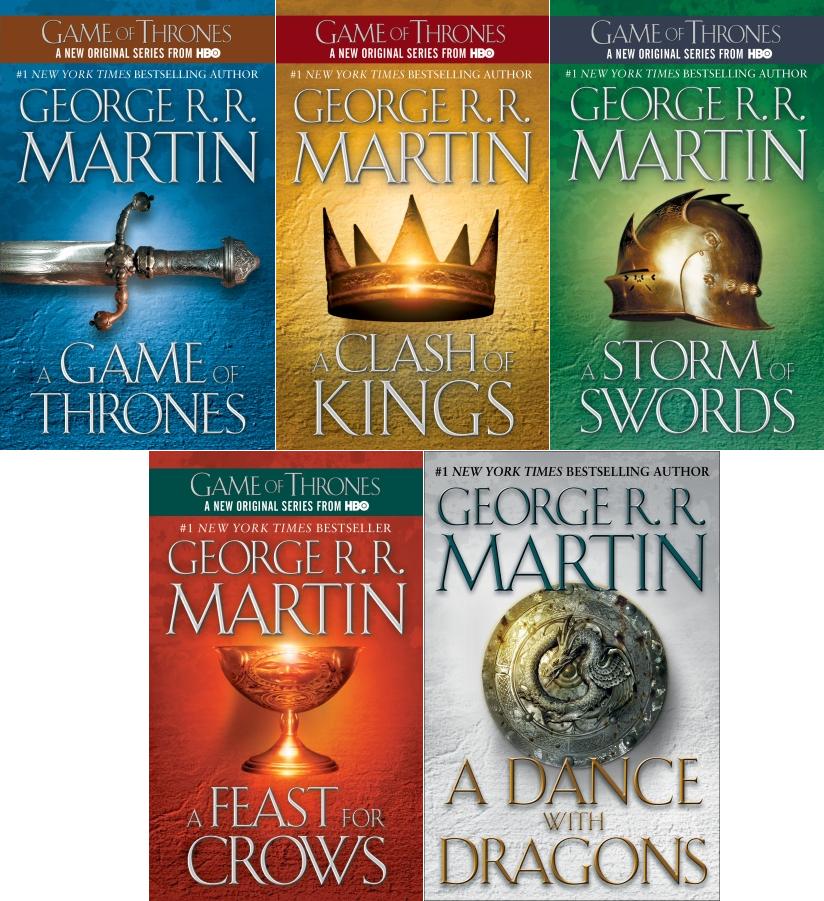
My thougts on A Song of Ice and Fire after I first read it a bit over 10 years ago.
The first time I read George R. R. Martin’s A Song of Ice and Fire series, I was 15 years old. It was not a book I sought out – instead, one day after work, my mother arrived with A Game of Thrones and handed it to me. I still remember it well; it was the version based on the TV series with Sean Bean sitting on the Iron Throne.
“The school librarian said this is a really good fantasy book,” she told me. That was all I knew about it; I had never heard of it before. “Good book” was one hell of an understatement, but that librarian is a hero for having the courage to recommend such a mature book for a 15 year old.
In the arrogance of youth, I remember thinking, “Well, there’s no ways a book could be as good as my fantasy video games. I’ll just read a few pages and see how it goes, but I am not expecting anything good.”
A few hours later I had moved away from PC and was reading a book on my bed for the first time in years. I do not think I had ever been as completely and utterly absorbed by a story before.
Both then and now, I think the series’ strongest aspect is that it is a story about human nature that just happens to be set in a fantasy world. Especially now on the reread at 26 years old, I realize just how incredibly deep Martin’s insights into the human psyche are. Many things that flew over my head at 15 now are incredibly relatable at 26 and I am sure if I were to read it again at 46 or 76 I would have the same experience. It is a story that could only be written by a person who has had a long life devoted to the study of human nature.
One of the things that stood out to me on this reread (now that I knew where the characters’ stories were going) is how incredibly consistent the characters and world are. So many stories I have read over the years – especially long ones – struggle to follow their own rules, but ASOIAF really does sew some seeds incredibly early that are so rewarding to watch bloom. I think the reason is that GRR does not meticulously plan out every plot detail, but instead allows the characters to drive the story and that ironically makes for a far more realistic narrative than an author who bends the characters to their vision.
For example, on the reread, Ned came across as a completely different character. When I first read it as a naïve boy, I saw him as you are taught to see fantasy protagonists: Here is the noble hero who will fight against the corruption of the Lannisters. On reread, as an adult, I was able to see his character a lot more clearly. Ned is noble and just, but he is also stubborn and gullible. By refusing to compromise on his morals, he led his entire family (and to an extent the entire realm) down a far more tragic road than they needed to. The worst part is that the people he was fighting were not even his enemies – they would not have cared about him at all if he never involved himself. From the start, Martin shows us that the road to hell (all seven of them, in this case) is paved by good intentions. He keeps that line throughout the entire series where characters are never equally punished or rewarded for their actions – everyone is a piece in someone else’s game and only power can keep you safe. Game of Thrones is such an apt (and very cool) name for a story and Martin is very lucky he was able to be the one to claim it.
Almost all of the characters were so different for me on reread. Cat went from being an annoying and paranoid mother ruining her son’s cool war chapters to being someone I deeply sympathised with since she turned out to be the only one who was trying to prevent more tragedy. She is such a noble and intelligent woman – I really did not appreciate her enough.
Maybe the biggest change for me was Cersei. When I first read her chapters in A Feast for Crows I remember hating them because I hated her so much. This time, I was able to read with a much more open/adult mind and her chapters are some of my favourite. There are many times where Martin’s use of unreliable narrators is expertly applied, but none more so than Cersei. The way she sees herself as some incredible mastermind while making worse decisions than even peak Robert is genuinely hilarious. Not to mention she has some of the most vile and out of pocket quotes in a series that is filled with taboos.
Mainly I was worried that after all this time, ASOIAF would not live up to the image of it I had built up in my mind. For a long time I have regarded it as my favourite series of all time, but I have read so much (and changed so much) since that first reading that I thought maybe it would be a disappointment.
It was not at all – in fact, if anything, it is held in even higher regard for me now. While I will not say it is my definitive favourite series of all time (the lack of an ending really throws a wet blanket over the experience), it is still a strong contender for the top spot and deserves all the success it has received.
Also, rereading the books has made me realize what an utter dumpster fire the TV series ended up being. Even the earlier seasons don’t hold a candle to the depth and nuance of the books, but they at least do them justice as an adaptation. Everything after Tyrion murdering Tywin is irredeemable dogshit (with the exception of the fantastic CGI dragons, excellent performances from most of the cast and some of the bigger set pieces are genuinely really well made. All of the blame deserves to be on the writers/directors. And whoever cast Kit Harrington).
 Shoganai Journal
Leave a comment